
 Mastering data center design requires far more than memorizing a few diagrams. The 300-610 DCID exam challenges candidates to understand how modern data centers operate, scale, and adapt to evolving workloads. Whether you are pursuing the CCNP Data Center certification or strengthening your architecture skills, the DCID blueprint provides the foundational design principles needed to build next-generation environments.
This guide breaks down the 300-610 DCID exam blueprint, explains the essential concepts you cannot afford to ignore, and gives you strategic insights to prepare effectively. You will walk away knowing exactly what the exam expects and how to align your study plan for success.
What the 300-610 DCID Exam Represents in Your Data Center Career
The 300-610 exam, officially titled Designing Cisco Data Center Infrastructure, evaluates your ability to design data center solutions that support both traditional and AI-driven workloads. According to the official exam overview on the Cisco Training & Certifications page, candidates must demonstrate strong design expertise across compute, network, storage, automation, and security architectures.
For professionals already working in data centers, DCID acts as a validation of architectural decision-making. For newcomers, it offers a structured path to learn how real-world data centers are designed, connected, and secured.
If your goal is the CCNP Data Center, the DCID exam is a required step. It builds the foundation needed to progress toward advanced design roles such as data center architect, solutions engineer, or infrastructure consultant.
Deep Dive into the 300-610 DCID Blueprint
The blueprint is organized into several major domains. Each one tests your ability to design scalable, resilient, and secure data center architectures. Below is a detailed breakdown to help you focus your preparation effectively.
1. Data Center Networking Design Essentials
Networking is the backbone of the 300-610 DCID exam. You will be evaluated on how different topologies and routing models are selected, optimized, and implemented. Key areas include:
Fabric Architectures
Candidates must understand how Cisco’s data center fabric technologies support modern application demands. This includes:
-
Spine-leaf topologies used for predictable east-west traffic flow
-
Traditional three-tier architecture and where it still applies
-
Design considerations for oversubscription, bandwidth planning, and scale
Expect questions comparing different architectures based on workload types or scalability requirements.
Layer 2 and Layer 3 Design
You must distinguish when to use Layer 2 vs Layer 3 boundaries within a data center. Be prepared to design for:
-
Layer 2 extension technologies
-
STP enhancements and replacement mechanisms
-
Routed access designs for improved stability
The exam often tests your ability to choose the correct model depending on redundancy, convergence time, and operational simplicity.
Routing Protocols and Multicast
Multicast design principles are frequently emphasized. Candidates must know:
-
PIM modes and their use cases
-
How multicast supports large distributed applications
-
Routing protocol selection (OSPF, BGP, IS-IS) for scale and policy control
The more you study real deployment scenarios, the more intuitive these decisions will become.
2. Designing Cisco Compute and Server Connectivity
The DCID blueprint dedicates significant focus to compute, storage connectivity, and virtualization. Expect to see questions that test not just technical knowledge, but the reasoning behind design choices.
UCS Architecture Fundamentals
You must understand the core components of Cisco UCS, including:
-
UCS Fabric Interconnects
-
UCS Manager design considerations
-
Server profile templates
-
Chassis and blade connectivity options
Exam questions commonly evaluate how UCS integrates with networking and how centralized management improves consistency.
Hyperconverged Infrastructure
Workloads for AI and high-performance applications increasingly rely on hyperconvergence. Your preparation must include:
-
Cisco HyperFlex architecture
-
Storage optimization in hyperconverged systems
-
Failure domains and node scaling considerations
Expect scenario-based questions assessing performance and resilience.
3. Data Center Storage Networking Design
Storage networking remains a critical exam component. The blueprint covers multiple technologies used to support enterprise-grade storage systems.
SAN Protocols and Fabric Architecture
You should understand:
-
Fibre Channel basics
-
VSANs and zoning
-
NPIV and NPV
-
Director-class switches and fabric redundancy
Candidates frequently struggle with SAN design terminology, so review how each protocol and topology affects performance and fault tolerance.
FCoE and Unified Data Center Designs
The exam expects you to know:
-
How FCoE integrates storage traffic into Ethernet
-
DCB technologies
-
FCoE topologies and limitations
This section often includes design trade-offs rather than configuration knowledge.
4. Designing Data Center Security Solutions
Security is integrated across all blueprint sections. The DCID exam evaluates whether candidates can design multi-layered protection that aligns with Cisco best practices.
Secure Network Segmentation
Expect to design secure environments using:
-
VRFs
-
Micro-segmentation
-
Policy-based access control
This includes scenarios where different tenants or application tiers require isolated communication.
Firewalling and Edge Security
Your preparation should include:
-
Data center firewall placement
-
North-south and east-west traffic inspection
-
Integration with Cisco ACI or traditional networks
Candidates must understand how security aligns with scalability and performance.
5. Designing Data Center Automation and Orchestration
Modern data centers depend on automation. The DCID exam ensures that candidates understand high-level automation concepts relevant to design decisions.
Infrastructure as Code Principles
Study how configuration consistency, repeatability, and reduction of human error support operational stability.
Cisco Intersight and DCNM
You should know:
-
What Cisco’s orchestration platforms do
-
How they support automated deployment
-
How telemetry and policy enforcement improve operational reliability
This section rarely focuses on configuration. It tests your understanding of the value of automation in large-scale environments.
6. Designing for High Availability, Scalability, and Disaster Recovery
This domain ties the entire blueprint together. Almost every exam scenario involves a business requirement such as uptime, resiliency, growth, or performance.
High Availability Techniques
Your preparation should include:
-
Redundant paths and devices
-
Failover mechanisms
-
Gateway redundancy design
Questions typically ask you to choose the design that best reduces downtime.
Scalability Planning
You must think beyond current workloads. Study how to design for:
-
Future capacity
-
Modular growth
-
Multi-site architectures
This is where your design mindset is tested most strongly.
Disaster Recovery
Expect to evaluate approaches such as:
-
Active/active vs active/passive sites
-
Data replication methods
-
Application recovery time objectives
Real-world reasoning is essential here.
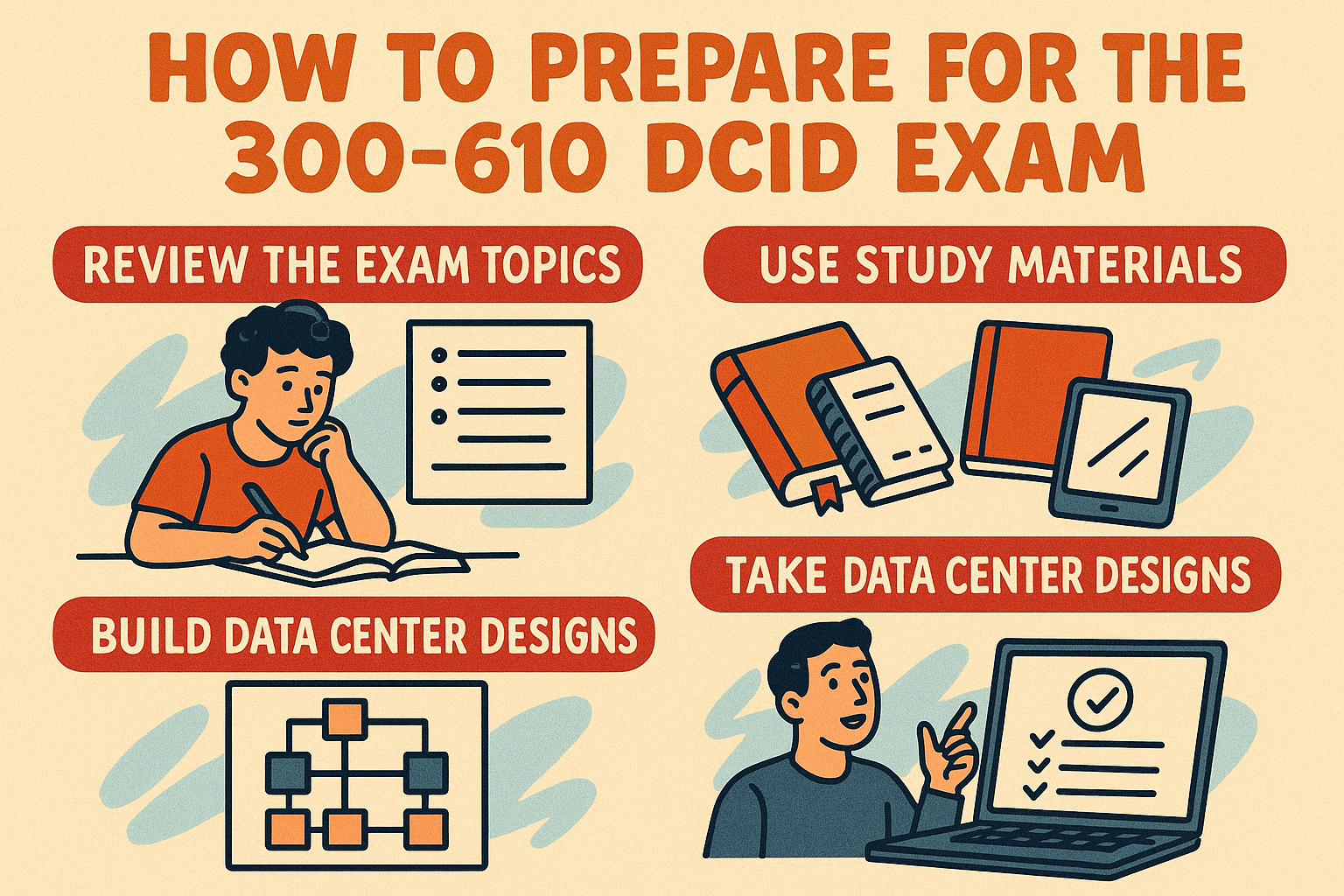
How to Study Effectively for the 300-610 DCID Exam
Understanding the blueprint is the first step. Structuring your preparation around practical insights is what ultimately leads to success.
1. Map Blueprint Topics to Real Deployments
Each DCID topic becomes much easier when connected to practical scenarios. Try recreating the reasoning behind architecture decisions rather than memorizing definitions.
2. Use Vendor-Backed Learning Resources
The official Cisco DCID exam page provides accurate details on test structure and expectations. This is your baseline reference for all study planning.
3. Practice Design Scenarios
Scenario-based practice is essential because the exam focuses on analytical reasoning.
High-quality practice tests such as those available on this 300-610 DCID resource offered by NWExam give you a realistic understanding of question patterns, making your preparation more aligned with real exam difficulty.
4. Review Key Technologies Daily
Keep a strong rotation of:
-
Fabric architectures
-
Routing protocols
-
SAN design principles
-
UCS and hyperconverged infrastructure
-
Security segmentation models
Daily spaced repetition helps reinforce long-term retention.
5. Build a Study Timeline
Divide your preparation across weekly milestones:
-
Week 1 to 2: Networking and routing design
-
Week 3 to 4: Storage networking
-
Week 5: Compute and UCS
-
Week 6: Security and automation
-
Week 7: Practice tests and review
-
Week 8: Final blueprint-level revision
A structured plan reduces stress and ensures comprehensive coverage.
Why Candidates Often Struggle With the DCID Exam
Even experienced engineers encounter challenges with the 300-610 DCID exam. Common difficulties include:
-
Overemphasis on configuration rather than design principles
-
Misunderstanding of fabric architecture trade-offs
-
Weak SAN and FCoE conceptual clarity
-
Limited exposure to multi-site designs
-
Inadequate practice with scenario-based questions
Recognizing these gaps early helps you avoid them.
Conclusion: Master the 300-610 DCID Blueprint With Confidence
The 300-610 DCID exam demands a deep understanding of data center design principles, from fabric architectures and routing decisions to storage networking, compute, security, and automation. When you study the blueprint thoroughly and reinforce your knowledge with real-world reasoning, you gain a design mindset that goes far beyond exam preparation.
Pairing official Cisco guidelines with practice resources such as the 300-610 DCID online practice tests available through NWExam ensures you approach the exam confidently and systematically. With the right strategy, this certification becomes an achievable milestone that elevates your data center career.
FAQs
1. What is the 300-610 DCID exam?
It is a Cisco professional-level exam focused on designing data center infrastructure, serving as a key requirement for the CCNP Data Center certification.
2. How many questions are in the 300-610 DCID exam?
Cisco does not publish an exact count, but candidates can expect a mix of scenario-based and conceptual questions.
3. What topics are included in the 300-610 DCID blueprint?
Networking, fabric designs, routing, SAN technologies, compute solutions, automation, and security.
4. Is the 300-610 DCID exam difficult?
Yes. The exam requires deep understanding of design principles rather than configuration commands, which many candidates find challenging.
5. How should I prepare for the DCID exam?
Use official Cisco documentation, follow the blueprint, and take realistic practice tests from reliable platforms.